Live football betting with crypto, explained
What in-play means
In-play betting, sometimes called live betting or betting in the run, simply means placing a wager while the match is already underway. The final whistle has not blown, the score is not fixed, and the odds you see are a snapshot of a market that is being repriced constantly. That is the whole idea, and it is also the source of almost everything that makes in-play different from a pre-match bet. When you back a team before kick-off, you are pricing a single moment: the line-ups, the form, the venue, the referee. When you back a team at 63 minutes, you are pricing a moving object.
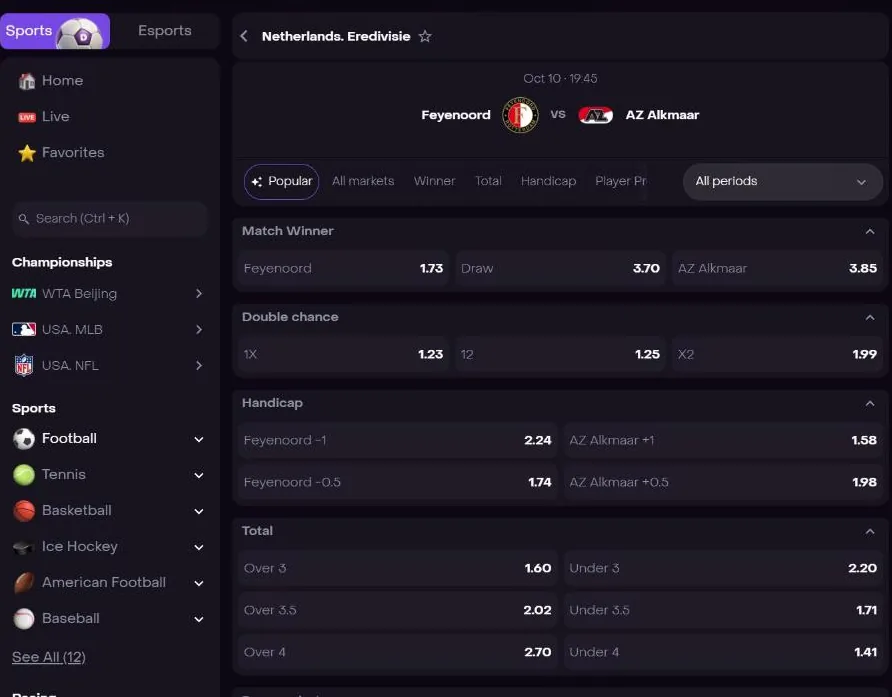
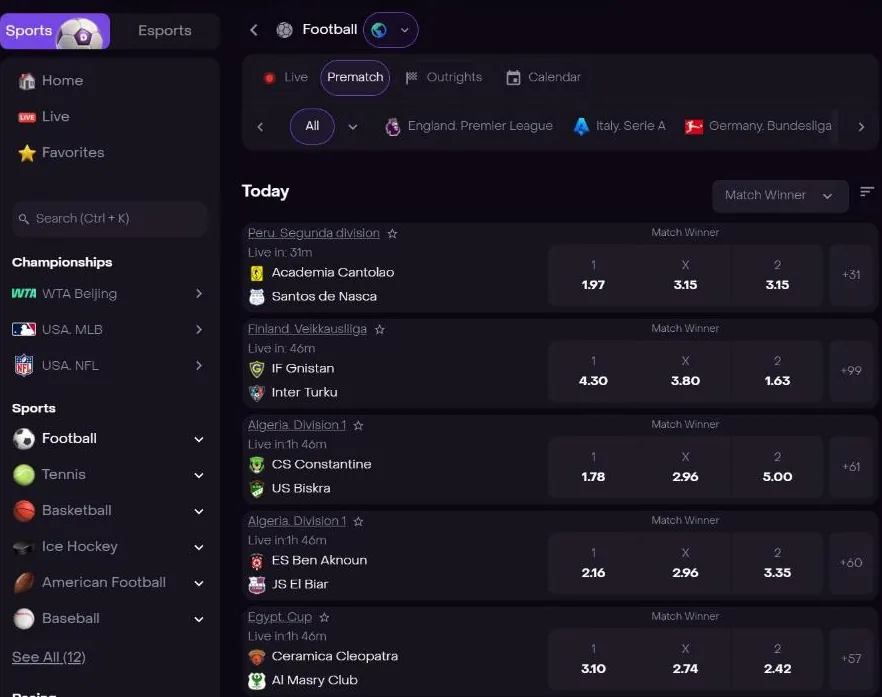
The mechanics matter more than most casual bettors realise. A live market is not one number that drifts; it is a set of interlocking prices across many outcomes — match winner, next goal, total goals, correct score, both teams to score, corners, cards, and so on. Each of those markets is connected. If the favourite scores, the match-winner price shortens, the draw lengthens, the over/under line shifts, and the next-goal market rebalances. A book that offers live football is running a small pricing engine in the background, and that engine is reacting to the same events you are watching on your screen.
The appeal is obvious. You can wait and see. If a side looks sluggish in the opening twenty minutes, you can hold off. If a red card changes the shape of the game, you can act on it. If you have a strong read on how a match is unfolding — a team pressing high, a defence sitting deep, a midfield being overrun — in-play lets you express that read with money at a price that reflects the current state of play rather than the pre-match consensus. In that sense, live betting rewards attention. A bettor who is genuinely watching can, in theory, hold an information edge over a market that is mostly being moved by the same feed everyone else sees.
But there is a catch, and it is a big one. The speed that makes in-play attractive also makes it punishing. Prices move in seconds, sometimes faster. A goal, a penalty, a VAR check, a substitution — any of these can wipe out the price you were about to take. If you are slow to confirm, you may get a different number than the one you saw, or the market may suspend entirely. Most books, including crypto-native ones, suspend live markets during major incidents: a penalty being taken, a VAR review, a goal being checked. During those windows you cannot get on at all, and by the time trading resumes the price has usually moved against the side that just had the good news.
There is also the question of what you are actually betting on. In-play markets are not always as clean as they look. A "next goal" market, for example, has a settlement rule about what happens if no further goal is scored — usually the bet loses, but you should read the terms, because some books void it instead. A "match winner" bet placed at 80 minutes with the score at 1-1 is really a bet on the last ten minutes plus stoppage time, and the price should be read that way. Understanding the exact conditions under which your bet wins, loses, or is voided is not optional in-play. It is the difference between a considered bet and a guess.
Finally, in-play is where the gap between a traditional sportsbook and a wallet-first crypto book becomes most visible. With a conventional account you are logged in, your balance sits with the operator, and settlement is an internal accounting entry. With a crypto book like Dexsport, you are betting from a wallet, and the flow of funds is different — you are not handing custody of your balance to a company in the same way. That changes the experience of live betting, mostly for the better if you value control, but it also means you need to understand how deposits, bets, and payouts actually move. That is the subject of a later section, but it is worth flagging now: the mechanics of in-play are one thing, and the mechanics of settling on-chain are another.
How odds move live
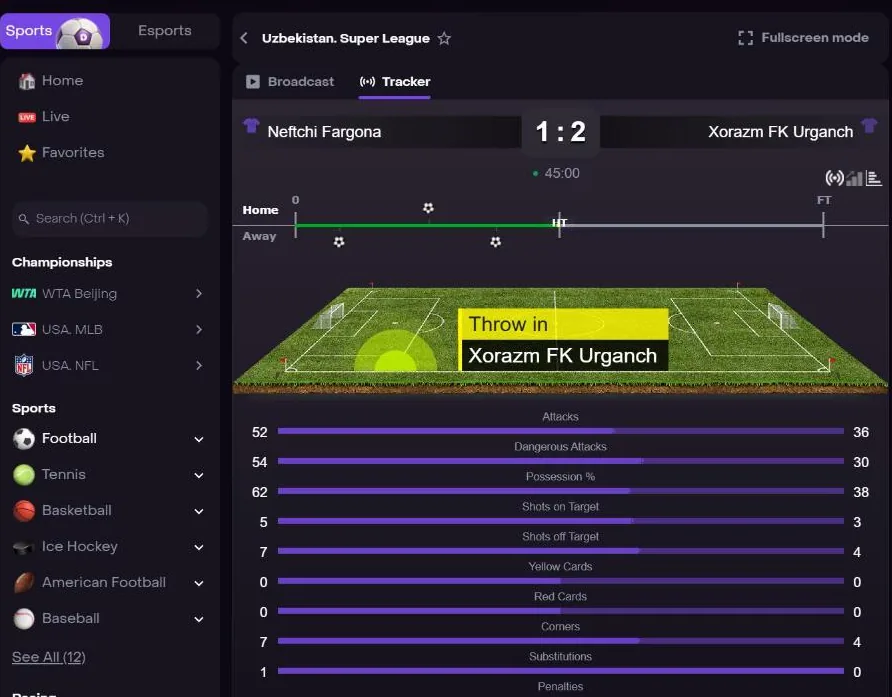
Live odds are driven by a pricing model that combines a base probability with a stream of incoming events. The base probability comes from the pre-match model — team strength, expected goals, home advantage, and so on. The event stream is what makes it live: goals, shots, possession, dangerous attacks, cards, substitutions, and the clock. Each event nudges the model, and the model nudges the price. A goal is the biggest single input, because it changes the scoreline and therefore the set of possible outcomes. But it is not the only one. A team that has had six shots on target in fifteen minutes will see its match-winner price shorten even at 0-0, because the model reads that as evidence of dominance.
The clock is a constant, quiet pressure on every live price. As time runs out, the number of remaining opportunities to change the score falls, so the probability of the current scoreline holding rises. That is why a 1-0 lead at 85 minutes is priced very differently from a 1-0 lead at 25 minutes. The favourite's price shortens not because anything happened, but because less time remains for the underdog to respond. If you have ever watched a live price drift steadily in one direction while the game looks static, this is why. Time itself is an input.
There is a second layer: the market's own money. A live book is not just modelling the match; it is managing its exposure. If a flood of money comes in on one side, the price on that side will shorten, partly because the book wants to discourage more of it and partly because the book is following the crowd's information. This is why live prices can move in ways that seem disconnected from the game. A price can shorten on a team that has done nothing, simply because a lot of money has arrived on it. Whether that money is smart or not is a separate question, but its effect on the price is real.
Liquidity matters here, and it is where crypto books differ from the big traditional operators. A large sportsbook with a deep book can hold a price steady through a burst of activity. A smaller or newer platform may move more sharply, or widen its margin, when volume spikes. That is not necessarily bad — it can mean better prices when the market is quiet — but it means you should not assume the price you see is stable. In fast-moving live markets, the number on your screen is an offer, not a guarantee, and it can be withdrawn or repriced before your bet is confirmed.
Margins, or the book's built-in edge, also behave differently in-play. Pre-match margins on major football markets are often tight, because competition between books is fierce and the event is well understood. Live margins are usually wider, because the book is taking on more risk and because the customer is, in theory, less able to shop around in the moment. A market that is priced at 2% overround before kick-off might be priced at 6% or more in-play. That difference is the hidden cost of live betting, and it is the reason a strategy that looks profitable on paper can bleed money in practice. You are not just betting on the match; you are paying for the privilege of betting on it while it happens.
The practical upshot is that live prices are informative but not authoritative. They tell you what the market currently thinks, weighted by the money already placed and the book's own risk position. They do not tell you what will happen. If you have a genuine read on a match — a team that is dominating without scoring, a defender on a yellow card who is being targeted, a goalkeeper who looks shaky — the live market may not have fully absorbed it yet. That gap, if it exists, is where in-play value lives. But it is a narrow gap, and it closes fast.
Settling on-chain
When you bet with a crypto sportsbook, the money you stake is not sitting in an internal account balance in the traditional sense. It is in a wallet you control, and the bet is a transaction. That distinction matters most at settlement, because settlement is where the two models diverge sharply. With a conventional book, a winning bet is credited to your account, and withdrawing it means a request, a review, and a wait. With an on-chain book, the payout is a transfer to your wallet, and the speed and finality of that transfer depend on the chain and the book's own process.
The first thing to understand is that not every crypto book settles every bet on-chain in real time. Some operate a hybrid model: your deposit is on-chain, but your betting balance is held by the platform, and only deposits and withdrawals touch the blockchain. Others, including Dexsport, are built around a wallet-first approach where the connection between your funds and the chain is more direct. The practical difference for you is custody. In the hybrid model, you are trusting the platform with your balance between deposit and withdrawal. In the wallet-first model, you are closer to holding your own keys, and the platform's role is to run the markets and settle the outcomes.
Settlement timing is the question every live bettor eventually asks. In-play bets are usually settled quickly after the relevant event resolves — a match-winner bet after the final whistle, a next-goal bet as soon as the goal is confirmed, an over/under bet once the threshold is crossed. On-chain, "quickly" can mean anything from near-instant to a few minutes, depending on the chain's block times and congestion. If you are betting on a fast-moving market and planning to reinvest winnings into another live bet in the same match, that lag matters. You may not be able to move funds as freely as you would with an internal balance.
There is also the question of what "settled" means when a result is disputed or corrected. Football has VAR, and VAR changes outcomes. A goal that is initially given can be ruled out minutes later. A penalty can be overturned. A red card can be downgraded to a yellow. Live markets usually suspend during these checks, but the settlement of bets placed before the check can be affected. A book that settles a next-goal bet the instant the ball hits the net, before the VAR check is complete, is taking a risk — and so are you, if you assume the goal stands. Reputable books wait for confirmation. The on-chain layer does not change this; it just means that when the book does settle, the result is a transaction rather than a database update.
Edge cases are worth thinking through. What happens if a match is abandoned — floodlight failure, crowd trouble, extreme weather? Most books have rules that void bets or settle them according to the official result at the time of abandonment, and those rules vary. What happens if a player you backed is substituted before scoring? What happens if a market is suspended mid-bet and your stake is returned? These are not exotic scenarios; they happen every season. With an on-chain book, the resolution still follows the book's terms, but the refund or payout arrives as a wallet transaction, which means you can verify it. That verifiability is one of the genuine advantages of the crypto model, and it is worth using: check the transaction, confirm the amount, and keep your own record.
One more thing. On-chain settlement is not free. Network fees apply, and they vary with congestion. On some chains a payout transaction costs a fraction of a cent; on others, during busy periods, it can be more noticeable. For large bets this is trivial. For small ones, it can eat into your edge, especially if you are settling frequently. A careful live bettor should factor fees into their staking, the same way they factor in the book's margin. It is not glamorous, but it is part of the arithmetic.
Pace and discipline
Live betting is the most psychologically demanding form of football betting, and the reason is simple: it is fast, it is continuous, and it is happening while you are emotionally invested in the match. The gap between seeing an opportunity and acting on it is short, and the gap between acting and regretting it can be even shorter. Discipline is not a nice-to-have here; it is the core skill. The bettors who do well in-play are usually the ones who do less, not more — they wait for specific situations, they size their bets carefully, and they stop when the match stops offering value.
The first discipline is knowing what you are looking for before the match starts. If you go into a game with no plan and simply react to whatever the live market throws at you, you are not betting on football; you are betting on your own impulses. A better approach is to identify, in advance, the situations where you think the market is likely to misprice. Perhaps you follow a team that tends to start slowly and finish strongly, so you look for value on them if they are trailing at half-time. Perhaps you know a particular league has a high rate of late goals, so you watch the over/under line as the clock runs down. The specifics are up to you, but the principle is the same: have a thesis, and let the live market either confirm it or not.
The second discipline is staking. Live odds move, and it is tempting to chase a price that is drifting away from you. If a team you fancied is now at a bigger price because they have conceded, that is not automatically value — it may simply be the market correctly repricing a worse situation. Doubling up to recover a losing live bet is the fastest way to turn a bad afternoon into a bad month. A fixed staking plan, decided before kick-off and adhered to during the match, is unglamorous and effective. It also protects you from the specific trap of live betting: the feeling that because the game is still going, you can always fix things.
The third discipline is attention. In-play betting is sold on the idea that you are watching the match and reacting to it, but in practice many bettors are watching the odds screen more than the pitch. That is backwards. The information that gives you an edge is on the pitch — the tempo, the body language, the tactical shape, the substitutions warming up. The odds screen tells you what the market thinks; the pitch tells you what is actually happening. If you are going to bet live, watch the game. If you cannot watch the game, you are at a disadvantage, and you should bet less or not at all.
There is also the question of how many markets you can realistically track. A live football match offers dozens of markets, and it is easy to spread your attention so thin that you are not really analysing any of them. Most successful live bettors specialise. They know one or two market types well — say, total goals and next goal — and they ignore the rest. That focus lets them notice when a price is out of line, because they have a feel for what the price should be. Trying to bet everything is a recipe for betting nothing well.
Finally, there is the stop rule. Live betting has no natural end until the final whistle, and that can keep you engaged long past the point where you are making good decisions. Decide in advance how much you are willing to lose in a session, and how much you are willing to win before you stop. The second part sounds odd, but it matters: a good live bettor who is up on the day can give it all back in twenty minutes of loose betting. Walking away when you are ahead is a skill, and it is one that the format actively discourages. If you cannot set that boundary, you should question whether live betting suits you.
A quick checklist
Before you place a live bet, it is worth running through a short set of questions. They are not complicated, but they catch most of the mistakes that cost money in-play. The first is whether you can actually watch the match. If you cannot, you are betting blind against a market that can see, and that is a bad starting position. The second is whether you know the settlement rule for the specific market you are considering. Next goal, match winner, total goals, and correct score all resolve differently, and some have void conditions you would not guess. Read them once, before you need them.
The third is whether the price you are seeing is the price you will get. Live markets move, and a bet placed at a number that has already changed is a different bet. If you are not comfortable with the possibility of a repriced or rejected wager, stick to markets that are less volatile or place your bets at calmer moments. The fourth is whether your stake is sized for the situation. Live betting encourages impulse, and impulse encourages oversizing. A stake that felt reasonable before kick-off can feel reckless at 70 minutes when the game is tense.
The fifth is whether you understand how your funds move. If you are using a crypto book like Dexsport, know whether your balance is held by the platform or sits in your wallet, know roughly how long settlement takes on the chain you are using, and know what the network fees look like. None of this is exciting, but it is the difference between a smooth experience and a confusing one. If a payout arrives as an on-chain transaction, check it. If a bet is voided, confirm the refund. The transparency is there; use it.
The sixth, and the one people skip, is whether you are still making decisions or just reacting. If you have been at it for two hours, if you are chasing, if the match has stopped being interesting and started being a way to recover a loss, stop. Close the app. The football will be there tomorrow. Live betting is a format that rewards patience and punishes restlessness, and the only person who can enforce that is you. This is not legal advice, and rules on betting vary by jurisdiction — check what applies where you are. If you do bet, bet only what you can afford to lose, and treat 18+ and responsible-gambling tools as part of the setup, not an afterthought.
This guide was produced with AI assistance and reviewed and fact-checked by the Live Score Wire editorial team before publication. Last reviewed 07.10.2026. Spotted something wrong? Tell us.