How to bet on the Eredivisie with crypto
Getting set up
The practical starting point for crypto Eredivisie betting is a wallet, not an account. That distinction matters more than it sounds. With a traditional Dutch bookmaker you open an account, verify your identity, and the operator holds your balance. With a wallet-first book such as Dexsport, you connect a self-custody wallet, deposit stablecoins or a major coin, and place bets directly from that balance. You control the keys the whole time. The trade-off is that you also carry the responsibility: lose your seed phrase and there is no support desk that can restore your funds. Write the phrase down on paper, store it somewhere physically safe, and never type it into anything that asks for it.
Fund the wallet before you think about the fixture list. Most people overcomplicate this step. You need a small amount of the chain's native token for gas — on an Ethereum L2 that is fractions of a cent per transaction, on mainnet it can be several euros, which is why L2s have become the default for smaller stakes. Then you need the stablecoin or coin you actually want to bet with. USDC and USDT are the common choices because they remove the currency wobble from your betting balance: a €50 stake stays roughly €50 in value whether you settle it tonight or next week. If you bet in ETH or SOL instead, your balance moves with the market, and a losing run can be compounded by a falling token.
Choosing a competition to follow is the next decision, and the Eredivisie rewards attention. Eighteen teams, thirty-four rounds, a winter break, and a title race that in recent seasons has usually involved two or three clubs rather than one runaway. That structure creates genuine pricing interest. Ajax, PSV and Feyenoord tend to be short in most markets, which means the value — if there is any — sits in the middle of the table, in the relegation scrap, and in the specific sub-markets where a bookmaker's model is less sharp. You do not need to watch every match. You need to know which matches you actually understand.
The regulatory picture in the Netherlands deserves a straight answer. Online gambling is regulated under the Wet Kansspelen op afstand, and licensed operators must hold a permit from the Kanssauthoriteit. Crypto sportsbooks generally operate outside that licensing framework, which means the consumer protections you would get from a licensed Dutch operator — deposit limits enforced at source, a Dutch dispute mechanism, access to Cruks self-exclusion — do not automatically apply. That is a real trade-off, not a detail. You are exchanging regulatory cover for wallet custody and, in many cases, no identity verification. Whether that exchange is worth it is your call, but make it consciously. This is not legal advice, and rules differ by jurisdiction; check your own position. Betting is for adults only, and if it stops being entertainment, stop.
One more setup point that people skip: decide your unit size before you deposit, not after. A unit is your standard stake, and it should be a fixed fraction of a bankroll you could lose without changing anything about your life. One to two percent is the conventional range. If your unit is €10, then a €10 stake on PSV to win at home is a normal bet and a €10 stake on a 40/1 correct score is also a normal bet — the stake is what you control, not the outcome. Fixing this number in advance is the single most effective thing you can do, and it costs nothing.
The main markets
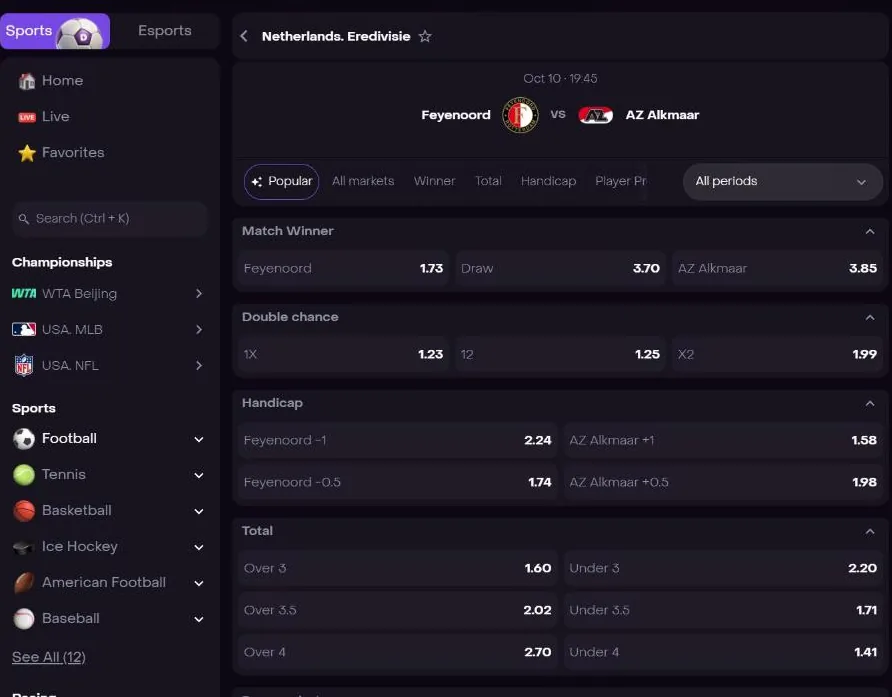
The 1X2 market is where most money sits, and it is worth understanding why it is harder than it looks. The Eredivisie is a high-scoring league, which pushes draw prices up and makes the favourite's price shorter than the raw team-quality gap might suggest. A home favourite at around 1.30 is not a value bet just because it usually wins; you need the implied probability to be wrong, not the result to be likely. Implied probability is simply one divided by the decimal odds. Odds of 1.30 imply roughly 77 percent. If you think the true chance is 80 percent, there is a thin edge. If you think it is 75 percent, you are paying over the odds even though the bet will usually win.
Over and under goals is the market where the Eredivisie's character shows most clearly. Total lines in this league often sit higher than in comparable European competitions, and that is not a quirk — it reflects genuine defensive openness across the division. The practical question is not "will there be goals" but "is the line set correctly for this specific pair". A mid-table side that presses high against a relegation candidate can produce a chaotic 3-2; the same side sitting deep against a title challenger might produce a controlled 1-0. Team news matters enormously here. An injured first-choice centre-back pairing can shift a total line by half a goal in the market, and if you have seen that news before the price moves, that is your edge.
Both teams to score is a close cousin and often a cleaner bet than the total. It asks a narrower question: do both sides have a realistic route to goal? It prices well when one team is strong going forward but leaky at the back, which describes a fair number of Eredivisie sides. The trap is the mismatch fixture where the underdog parks the bus and the game finishes 3-0. BTTS is not a proxy for "entertaining match"; it is a specific bet on both attacks functioning, and it fails when one team's attacking plan is simply to survive.
Handicap and Asian handicap markets deserve more attention than they get from casual bettors. A -1 handicap on a strong favourite means the favourite must win by two or more for your bet to land, and it converts a short 1.30 price into something closer to even money. That is the mechanism: you are trading certainty for price. The Asian version removes the draw from the equation by refunding your stake on a one-goal win, which is a genuinely useful tool when you expect a comfortable but not emphatic victory. The trade-off is complexity — you need to understand the quarter-line variants, where half your stake sits on one line and half on another — and complexity is where careless money goes.
Goalscorer and player markets are the sharpest edge and the sharpest trap. An anytime goalscorer price on a striker in good form looks attractive, but the bookmaker's model already knows the form, the fixture, and the expected team goals. Where you can find an edge is in role changes: a winger who has started taking penalties, a striker returning from injury who is being eased back with fewer minutes, a team that has switched to a two-striker system. Those are observable facts that move true probability before they move the price. What you should avoid is betting a name because you like the player. That is not analysis.
Correct score and half-time markets are where recreational money goes to die, and it is worth saying so plainly. The prices are long, which feels exciting, and the margins are wide, which means the bookmaker's edge is larger than in the main markets. If you bet them, bet them small, and treat them as entertainment rather than as part of a serious approach. The same applies to accumulators. A five-fold parlay multiplies the odds and multiplies the bookmaker's margin with it. There is nothing wrong with a small accumulator on a Saturday, but it should not be your core strategy, because the compounding of margins works against you in a way that single bets do not.
Reading the table first
Before you look at any odds, look at the table — but read it properly, not just the points column. Goal difference tells you more about a team's true level than its position in October, because early-season tables are noisy. A side sitting fifth with a negative goal difference is probably overperforming its underlying numbers and is a candidate to regress. A side sitting twelfth with a positive goal difference is probably underperforming and may be priced generously in its next few fixtures. This is not a secret method; it is just the discipline of looking past the headline number.
Home and away splits matter more in the Eredivisie than in some leagues, partly because the gap between the top and bottom of the division is large and partly because travel is short and away followings are vocal. Some mid-table clubs are genuinely formidable at home and poor on the road, and the market sometimes prices them as if they were average in both. If you track a club's home and away records separately across a season, you will start to see which ones the market misprices. That is a slow-burn edge, built over months, not a shortcut.
Fixture congestion is the variable most casual bettors ignore and most professionals watch closely. Dutch clubs in European competition play midweek fixtures that the rest of the league does not, and the effect on a Thursday-night Europa League side playing Sunday afternoon is real. Rotation is heavier, intensity drops, and results become less predictable. If a title contender has played a tough European away leg on Thursday, its weekend price may not fully reflect the fatigue. Conversely, a mid-table side with a clear week is often fresher than its reputation suggests.
Motivation is the least quantifiable factor and the one that trips up model-driven bettors. A team with nothing left to play for in April, safe from relegation and out of the European places, does not always perform to its underlying numbers. A team fighting relegation in the same fixture will. The market knows this in general terms but does not always price it precisely, particularly in the final third of the season. Reading the table means reading the stakes, not just the standings.
Injury and suspension news is the final piece, and it is where the table meets the team sheet. A club's league position tells you what it has done; the availability list tells you what it can do next. If a side's creative hub is suspended and its backup is a teenager with a handful of appearances, the market may not have adjusted fully by the time you look. That is a genuine informational edge, and it is available to anyone willing to check the team news before the price moves rather than after.
Live betting the matches
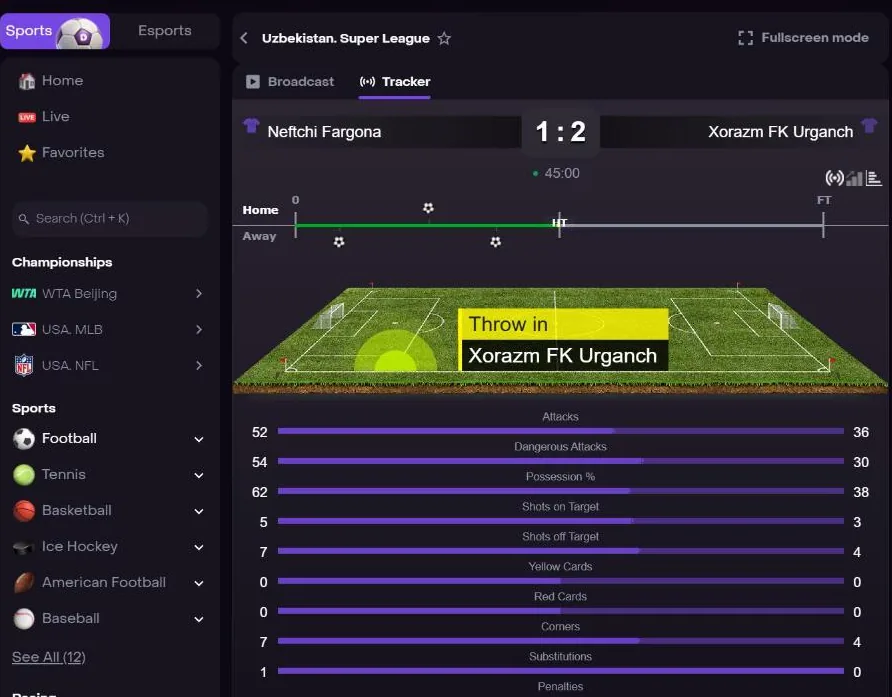
In-play betting changes the game because the price moves with events, and the Eredivisie's high-scoring nature makes those moves large. A favourite that concedes early can drift from 1.30 to 2.50 within minutes. Whether that drift is an opportunity or a warning depends entirely on why the goal happened. A deflected shot and a goalkeeping error are noise; a genuinely carved-open defence is signal. The skill in live betting is distinguishing between the two before the market finishes repricing.
The mechanism matters. Live prices are generated by models that update on the score, the clock, and the flow of the match, and they are often shaded by the money already in the market. That means the price you see is not a pure probability — it is a probability adjusted for liability. When a lot of money has already backed the favourite, the live price on the favourite can be shorter than the true chance, and the price on the underdog longer. Reading that shading is part of the craft, and it is why the same event can be value in one direction and a trap in the other.
Timing is the hardest part. Bet too early and you are reacting to a single event with limited information. Bet too late and the price has already corrected. The window where a live edge exists is often only a few minutes, and it requires you to have a view on the match before kick-off. If you go into a game without a prior opinion, live betting becomes reactive gambling, which is exactly the behaviour that erodes a bankroll. The discipline is to have a pre-match thesis — say, that the away side's midfield will struggle without its holding player — and then use the live market to get a better price on that thesis when an early goal goes against it.
There is also a practical constraint that wallet-first books handle differently from account-based ones. Because you are betting from a connected wallet, each bet is a transaction, and on a busy matchday the confirmation can take a moment. That is usually fine, but it means you should not be trying to fire off a live bet in the final seconds of a half. Plan the bet, size it, and place it with enough time for the transaction to settle. Treating live betting as a twitch-reflex activity is how people end up with stakes they did not intend.
The liquidity question is real and worth stating honestly. Live markets on smaller Eredivisie fixtures are thinner than on a Champions League night, which means prices can move sharply on modest money and the best available price can vanish quickly. If you are betting a relegation six-pointer on a Sunday afternoon, expect less depth than you would get on a PSV–Ajax clash. That is not a reason to avoid live betting on those games; it is a reason to be realistic about what you can get filled, and to avoid chasing a price that has already gone.
Staying disciplined
Discipline is not a personality trait; it is a set of rules you write down and then follow when you do not feel like it. The first rule is stake sizing, and it should be mechanical. A fixed percentage of bankroll per bet removes the emotional decision from the moment of placing the bet, which is exactly when your judgement is worst. If you find yourself wanting to increase the stake because you "feel good" about a match, that is the signal to keep it at the standard unit, not to raise it.
The second rule is record-keeping, and it is non-negotiable if you want to know whether you are actually any good. Log every bet: date, fixture, market, stake, odds, and result. Over a few hundred bets, patterns emerge that memory cannot produce. You may discover that your over/under bets are profitable and your 1X2 bets are not, or that you do well on Saturday fixtures and badly on Sunday ones. That information is worth more than any tipster, and it costs you nothing but a spreadsheet.
The third rule is about chasing. A losing run is normal and expected; even a genuinely profitable bettor will have stretches of ten or fifteen losing bets. The danger is not the losing run itself but the response to it — increasing stakes to recover, switching to long-odds markets for a quick fix, or betting on matches you have not researched. All three are ways of converting a variance problem into a bankroll problem. The correct response to a losing run is to keep the unit size the same and keep taking the bets you believe are value.
The fourth rule concerns the wallet itself. Because crypto betting is self-custodied, there is no operator-imposed deposit limit standing between you and your funds. That is the freedom and the risk in the same package. Set your own limit before you start, keep your betting balance separate from your savings, and treat the transfer from cold storage to betting wallet as a deliberate act rather than a casual one. If you would not move the same amount from your bank account to a bookmaker without thinking, do not move it from your wallet without thinking either.
Finally, know when to stop, and mean it. The Dutch gambling authority operates Cruks, a national self-exclusion register, and licensed operators must check it. Crypto books generally do not, which means the responsibility for self-exclusion sits with you. If betting has stopped being a hobby you fund from disposable income and started being something you fund from money you need, that is the point to stop, not the point to win it back. Support is available through Dutch services such as Loket Kansspel, and using it is not a failure. Betting is for adults aged 18 and over, it carries real financial risk, and no strategy removes that risk entirely. This article is general information, not legal or financial advice, and the regulatory position for crypto betting in the Netherlands is something you should verify for yourself before depositing anything.
This guide was produced with AI assistance and reviewed and fact-checked by the Live Score Wire editorial team before publication. Last reviewed 07.10.2026. Spotted something wrong? Tell us.