An Eredivisie betting guide for crypto bettors
How the league is shaped
The Eredivisie is an eighteen-team competition that runs from late summer to spring, with each club playing the other seventeen twice, once at home and once away. That gives thirty-four rounds and a final table decided on points, with goal difference and then goals scored as the tiebreakers. Promotion and relegation connect it to the Eerste Divisie below, and European qualification slots sit at the top, which matters more than it first appears: the shape of the season is not just about who wins the title, but about which places carry continental money and which carry the threat of the drop. For a bettor, that means late-season matches are often played under very different incentives from mid-autumn fixtures, and the same teams can behave quite differently depending on what is at stake.
Structurally, the league is top-heavy. A small group of clubs — traditionally Ajax, PSV and Feyenoord, with AZ and occasionally others pushing in — carry budgets and squad depth that the rest cannot match. That concentration produces a predictable pattern: the champions usually come from that group, and the gap in points between first and fourth is often larger than the gap between fourth and tenth. This is the single most important fact for anyone pricing Eredivisie markets, because it shapes both the favourites and the way odds are set. Bookmakers know the hierarchy as well as you do, so the edge rarely comes from simply backing the biggest club.
The league also has a distinctive stylistic character. Dutch football prizes possession, positional play and technical development, and even mid-table sides tend to try to play rather than park the bus. The practical consequence is goals. Eredivisie matches average more goals than most comparable European leagues, and that has knock-on effects for betting: over/under lines sit higher, correct-score markets are wider, and both-teams-to-score is priced shorter than you might expect from an English or Italian frame of reference. If you carry intuitions from other leagues, they will mislead you here unless you adjust.
Scheduling adds another layer. The Dutch calendar includes a winter break, and the league has to coexist with European commitments for the clubs that qualify. A team in the Champions League or Europa League faces midweek travel and rotation, and that fatigue shows up in the league table in ways that are not always obvious from recent results alone. A side that has just played a demanding European away tie on Thursday may look strong on paper but field a rotated eleven on Sunday. Reading team news is not optional in this league; it is part of the core analysis.
Finally, the financial gradient matters for how squads behave across a season. The top clubs can absorb an injury to a key player; a mid-table side often cannot. When a smaller club loses its main striker or its organising midfielder, the drop in performance can be steep and sudden, and the market does not always reprice quickly enough. Conversely, the big clubs sometimes coast against weaker opposition, especially when a European fixture looms, which is where some of the more interesting value appears. Understanding the league's shape is really about understanding these asymmetries before you look at any odds.
Favourites and form
The favourites in the Eredivisie are not a mystery, and that is precisely the problem. Ajax, PSV and Feyenoord are priced short almost every week, often at odds that imply a win probability well above what a fair model would suggest once you account for rotation, travel and the simple variance of a single match. The temptation for a new bettor is to treat these clubs as a reliable source of accumulators, stringing three or four short favourites together for a modest return. It works often enough to feel safe, right up until it does not, and a single draw or shock defeat wipes out the whole slip. The maths of short-priced multiples is unforgiving.
Form in this league needs to be read carefully, because the raw run of results can flatter or mislead. A five-match winning streak against the bottom half tells you less than a two-match run against top-six opposition. The useful question is not "how many did they win" but "who did they beat, where, and how". A side that has taken points away at a strong opponent is showing something different from one that has beaten relegation candidates at home. When you see a club on a good run, check the fixture list behind it before you decide the form is real.
There is also a well-documented tendency for markets to overreact to recent results. After a heavy defeat, a good team's price drifts; after a comfortable win, it shortens. Both moves can be excessive. The classic value spot is a strong club coming off an unlucky loss — a match where it created chances but conceded from a deflection or a set piece — against a weaker opponent the following week. The market remembers the scoreline; a careful bettor remembers the underlying performance. That gap between result and process is where a lot of the sustainable edge lives.
Home advantage in the Eredivisie is real but uneven. Some grounds are genuinely difficult for visiting sides, whether because of atmosphere, pitch dimensions or travel, while others are far more welcoming. The league-wide home win rate is meaningful, but it is not uniform, and treating all home fixtures as equivalent is a mistake. Clubs with a strong home record against the top sides, in particular, can be interesting when they host a favourite, because the market often prices the away team's reputation rather than the specific difficulty of the trip.
Injuries and suspensions deserve more weight than they usually get. Because the talent gap is wide, the loss of one or two key players hits a smaller club harder than a big one. If a mid-table side is missing its creative midfielder and its first-choice centre-back, the market may still price it as roughly the same team it was three weeks ago. That lag is exploitable. The flip side is that top clubs rotate heavily, so "injuries" at Ajax or PSV sometimes mean less than the headline suggests, because the replacement is nearly as good. The skill is in judging which absences actually change the team's level.
Finally, be sceptical of narratives. The Dutch media, like any national football press, builds stories around momentum, crises and turning points, and those stories bleed into prices. A "crisis" at a big club after two poor results is rarely as severe as it sounds, and a "revival" under a new manager is rarely as smooth as the first match suggests. Your job is to translate the noise back into probabilities, not to join the conversation. Form is a signal, but it is a noisy one, and the market has usually already heard the story you are reacting to.
Where value hides
Value in Eredivisie betting tends to sit away from the headline markets. The match-winner prices on the biggest clubs are efficient because they attract the most attention and the most money, which means the bookmaker's margin is squeezed and the true edge is thin. The less glamorous fixtures — two mid-table sides, or a lower-half team hosting another lower-half team — get less scrutiny, and that is where mispricing is more likely to survive. If you only ever bet the games you would watch anyway, you are competing in the most efficient part of the market.
Draws are a recurring source of value in this league, though not for the reason people often assume. Because the top clubs are priced so short, the draw in matches involving a heavy favourite is frequently offered at generous odds relative to its true probability. A favourite that is "supposed" to win comfortably still draws a meaningful share of the time, especially away from home and especially when rotation or a European fixture is in play. Backing the draw is not a glamorous strategy, but in specific spots it can be a disciplined one. The key is selectivity: not every favourite is vulnerable, and the draw price is only value when the underlying probability is genuinely higher than the odds imply.
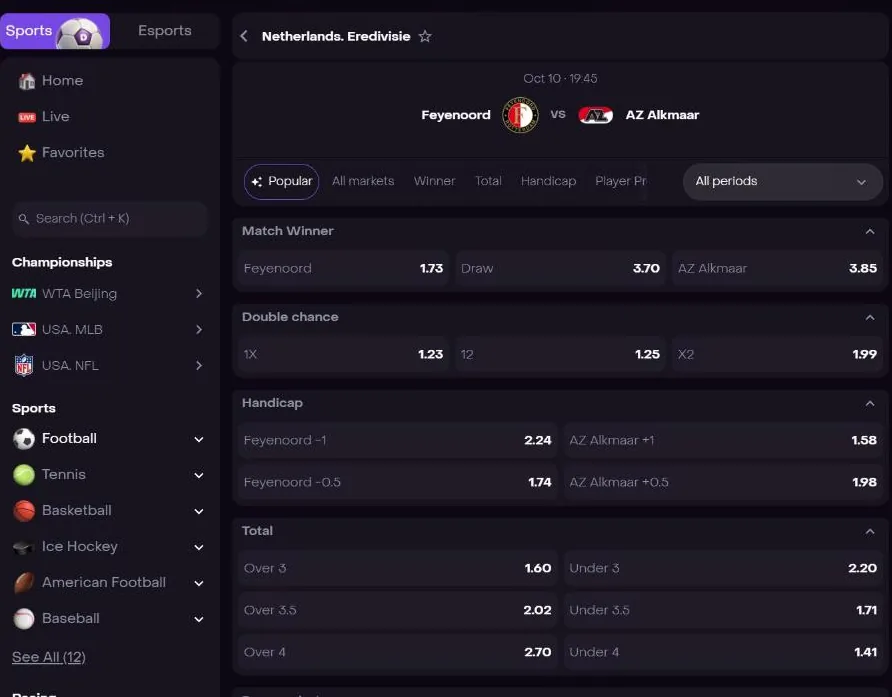
Handicap and Asian handicap markets are where more sophisticated bettors do much of their work. Instead of asking whether a team wins, you ask whether it wins by enough, which removes the binary of the result and lets you express a view on margin. If you think PSV will beat a bottom-half side but the straight win is priced at odds too short to bother with, the handicap line may offer a better return for a slightly riskier proposition. The trade-off is real: you can be right about the winner and still lose the bet. But it also means you are not forced to choose between an unappealing short price and no bet at all.
Goals markets deserve attention because of the league's high-scoring character. Over 2.5 goals is a common default, but the interesting work is in the totals lines further out and in the team-specific goal markets. Some Eredivisie sides are reliably involved in high-scoring games; others are tighter than the league average suggests. If you can identify which teams consistently produce goals and which do not, you can find spots where the market's generic line does not fit the specific fixture. Both-teams-to-score is similar: it is priced on league-wide assumptions, and individual matchups can diverge from that baseline.
Promotion, relegation and European qualification markets offer a different kind of value because they are season-long and less efficiently priced than single matches. The market for "top four finish" or "relegation" reflects a view about a whole campaign, and that view can be slow to update when a club's circumstances change — a managerial switch, a January signing, a run of injuries. These markets also tie up your stake for months, which is a genuine cost, and they carry the risk that a single bad month derails an otherwise sound thesis. They suit patient bettors with a strong read on the league, not those who want quick turnover.
There is also value in simply not betting. The Eredivisie offers dozens of matches a week across all competitions, and the pressure to have action on every one is a trap. Passing on a fixture where you have no edge is a decision, and often the correct one. The bettors who last are the ones who treat the absence of value as information rather than as a gap to be filled. If you use a wallet-first book like Dexsport, where you are not pushed toward a welcome bonus or a loyalty scheme, it is easier to sit out the games you do not like, because nothing in the interface is nudging you to keep staking.
Markets beyond the winner
Once you move past the match result, the Eredivisie opens up a wide set of markets, each with its own logic. Correct score is popular but brutal: the odds look attractive, and the hit rate is low, because you are predicting an exact outcome in a league where goals come in bunches. It can be a reasonable small-stake play when you have a strong read on a specific fixture, but it should not be a core strategy. The variance is punishing, and even a good model will miss far more often than it hits.
Goalscorer markets are more tractable if you follow the league closely. The top scorers are well known and priced accordingly, but the value often sits with players who take penalties, who play in advanced positions for teams that create a lot, or who are undervalued because they play for a less fashionable club. The catch is that starting lineups are not always certain, especially at clubs with rotation or European commitments, and a goalscorer bet on a player who is rested or comes off the bench is a wasted stake. Always confirm the team news before committing, and be aware that some books void or adjust bets if a player does not start.
Half-time markets and the "both halves" angles can be useful against specific opponents. Some teams start slowly and grow into games; others fade after the break. If you have noticed a consistent pattern for a club — conceding early, or scoring late — the half-specific markets may price it less precisely than the full-match markets. These are niche, and the liquidity is thinner, which means the odds can be less competitive, but for a bettor with a genuine read on a team's tempo, they can be worth a look. As always, the edge has to survive the margin.
Cards, corners and other event markets are increasingly available and increasingly priced by models, which makes them harder to beat than they look. Corners, in particular, are heavily influenced by game state: a team chasing a match takes more corners, a team protecting a lead takes fewer. If you bet corners without accounting for how the game is likely to unfold, you are guessing. That said, for teams with a very distinctive style — a side that crosses constantly, or one that sits deep and invites pressure — the corner lines can occasionally be mispriced, especially in less-watched fixtures.
Outright and ante-post markets round out the picture. Betting the league winner before the season starts is a long commitment with limited liquidity, and the top clubs are priced so short that the return rarely justifies the risk of an injury crisis or a managerial change. The more interesting ante-post plays are in the places below the title: top-four finishes, European qualification, and relegation. These markets reward a genuine understanding of squad depth and financial stability across the division, and they are less crowded than the title market. They also demand patience, because your stake is locked away for months.
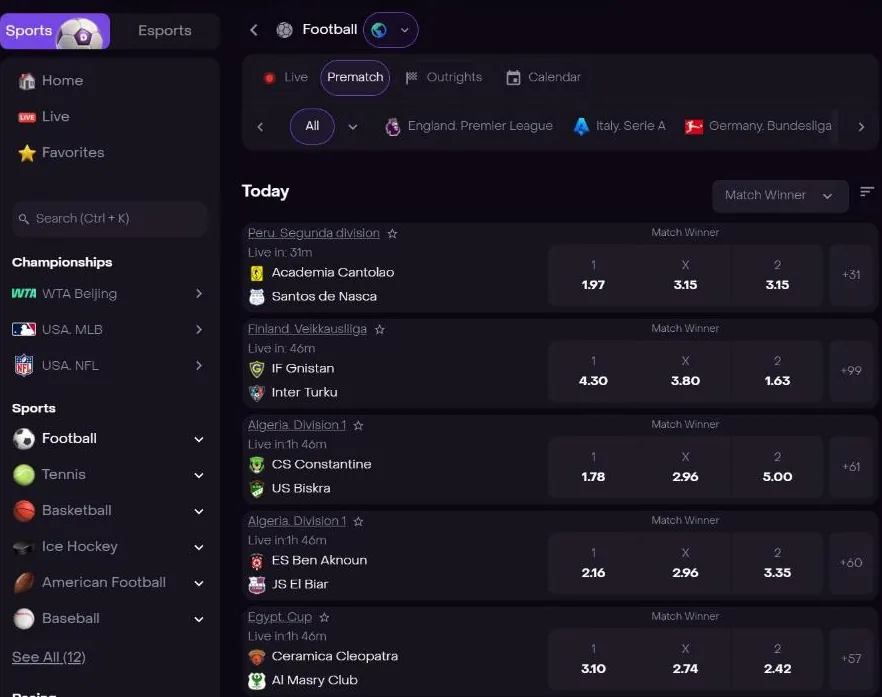
Finally, consider how market availability itself varies. Some crypto-native books, Dexsport among them, list a broad range of football markets without the account friction of a traditional operator, which makes it easier to shop around and to place smaller, more experimental bets. But breadth is not the same as value, and a market being available does not make it a good bet. The discipline is the same regardless of where you place it: identify the price, compare it to your own estimate, and only act when the gap is in your favour. If you cannot articulate why a price is wrong, you do not have an edge — you have a hunch.
A sensible approach
Start with a method, not a market. The most common mistake in Eredivisie betting is to pick a bet first and then find reasons to justify it. A better sequence is to build a rough model of each match — expected goals, likely lineups, home advantage, motivation — and only then look at the odds to see whether any of them diverge from your estimate. This is slower, and it means you will bet far less often, but it forces you to have a reason for every stake. If you cannot explain your edge in one sentence, you probably do not have one.
Bankroll management is not a cliché; it is what keeps you in the game long enough for a real edge to show. Because the Eredivisie is high-variance and the favourites are short-priced, a flat-staking approach — the same percentage of your bankroll on every bet — is usually more robust than chasing bigger returns on "certain" outcomes. The temptation to stake more on a heavy favourite is exactly backwards, because those are the bets with the least value. Size your stakes by your confidence and your edge, not by how obvious the result feels.
Keep records. Not just of what you bet and what it returned, but of why you placed each bet and whether the reasoning held up. Over a season, patterns emerge: you may find you are consistently good at goals markets and consistently poor at correct score, or that your reads on mid-table sides are sharper than your reads on the top clubs. Without records, you are relying on memory, which is biased toward recent results and memorable wins. With records, you can actually improve, because you can see where your judgement is reliable and where it is not.
Be careful with accumulators. They are the most heavily promoted product in football betting and the least favourable to the bettor, because the bookmaker's margin compounds with every leg you add. A four-fold of short-priced favourites can look like easy money and still lose more often than the odds suggest. If you enjoy them, treat them as entertainment with a small stake, not as a strategy. The single bets, priced carefully and placed selectively, are where a genuine edge can survive the margin.
Finally, treat the legal and practical side with the care it deserves. Gambling rules vary by jurisdiction, and what is permitted where you live may differ from what you read online; nothing here is legal advice, and you should check your own local regulations before betting. Whatever platform you use, whether a wallet-first book like Dexsport or any other, the same principles apply: only stake money you can afford to lose, set limits before you start rather than after a bad run, and take breaks when betting stops being a considered activity and starts being a reflex. This is written for adults aged 18 or over, and if gambling is causing you or someone around you harm, stop and seek support. A guide can help you think more clearly about the Eredivisie; it cannot make the risk disappear.
This guide was produced with AI assistance and reviewed and fact-checked by the Live Score Wire editorial team before publication. Last reviewed 07.10.2026. Spotted something wrong? Tell us.